
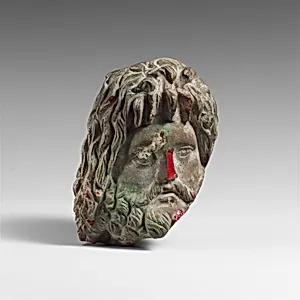
Glass head of Zeus Sarapis
Unknown Artist
1st–2nd century CE
Medium
Glass
Dimensions
H. 3 3/4 in. (9.5 cm)
Classification
Glass
Culture & Period
Roman · Early or Mid Imperial
Department
Greek and Roman Art
Museum
Metropolitan Museum of Art, New York, NY
Credit
Gift of J. Pierpont Morgan, 1917
Accession Number
17.194.1475
Rights
Public Domain
Tags
Art Historical Context
Welcome to the Greek and Roman Art galleries at the Metropolitan Museum of Art, where you'll find the delicate *Glass Head of Zeus Sarapis*, a small yet captivating artifact from the Early or Mid Imperial Roman period (1st–2nd century CE). Standing just 3 3/4 inches (9.5 cm) tall, this translucent glass portrait captures the powerful visage of Zeus Sarapis—a syncretic deity blending the Greek king of the gods, Zeus, with Serapis, the Hellenistic-Egyptian god popularized in the Roman Empire. Gifted by J. Pierpont Morgan in 1917, it exemplifies the artistry of anonymous Roman glassmakers. Crafted in glass, a medium that flourished in the Roman world thanks to innovative techniques like mold-blowing and free-blowing, this head likely served as a decorative finial, amulet, or vessel attachment. Its modest size belies its cultural weight: Zeus Sarapis symbolized imperial power and religious fusion, bridging Greek mythology, Egyptian cults, and Roman devotion. Temples to Serapis dotted the empire, from Alexandria to Rome, making such images potent talismans for protection and prosperity. This piece invites us to marvel at Roman ingenuity—transforming everyday material into divine portraiture—and reflects the empire's vibrant religious landscape. A true gem for lovers of ancient glass!