
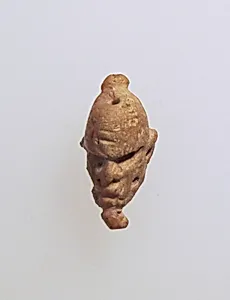
Glass head pendant
Unknown Artist
3rd–2nd century BCE
Medium
Glass
Dimensions
Other: 3/4 x 3/8 x 3/8 in. (1.9 x 1 x 1 cm)
Classification
Glass
Culture & Period
Phoenician or Carthaginian · Hellenistic
Department
Greek and Roman Art
Museum
Metropolitan Museum of Art, New York, NY
Credit
Gift of J. Pierpont Morgan, 1917
Accession Number
17.194.645
Rights
Public Domain
Tags
Art Historical Context
This delicate glass head pendant, crafted in the 3rd–2nd century BCE, hails from Phoenician or Carthaginian culture during the Hellenistic period—a time when Greek influences blended with vibrant Eastern Mediterranean traditions following Alexander the Great's conquests. Measuring just 3/4 x 3/8 x 3/8 inches, its miniature scale suggests it was designed as personal jewelry, perhaps worn as a necklace or amulet, evoking the intimacy of ancient adornments carried close to the body. Glassworking reached remarkable sophistication in Phoenician and Carthaginian hands, renowned traders who pioneered techniques like core-forming, where a mold of clay or sand was wrapped with molten glass threads in vivid colors. This pendant exemplifies their skill in producing translucent, lightweight objects that captured light beautifully, making luxury accessible beyond elite metals. The human head motif, rendered with precise detail, hints at portraiture, deity worship, or protective symbolism common in the era. A generous gift to the Metropolitan Museum of Art from J. Pierpont Morgan in 1917, this artifact bridges the Greek and Roman Art collection with the dynamic world of Punic craftsmanship, offering a glimpse into the cultural exchanges that shaped the ancient Mediterranean.