
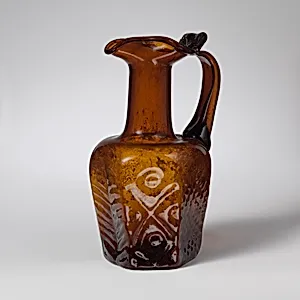
Glass hexagonal jug
Unknown Artist
6th–early 7th century CE
Medium
Glass
Dimensions
H. 5 3/8 in. (13.7 cm)
Classification
Glass
Culture & Period
Roman, Palestinian · Early Byzantine
Department
Greek and Roman Art
Museum
Metropolitan Museum of Art, New York, NY
Credit
Museum Accession
Accession Number
X.21.187
Rights
Public Domain
Art Historical Context
This delicate glass hexagonal jug, crafted by an unknown artist in Roman Palestine during the Early Byzantine (6th–early 7th century CE), stands just 5⅜ inches (13.7 cm) tall. Its six-sided form is a striking example of the era's glassworking prowess, likely produced using techniques refined over centuries in the Levant, a hub of glass production under Byzantine influence. Housed in the Metropolitan Museum of Art's and Roman Art Department, small vessel invites us to imagine its role in daily life—perhaps holding oils, perfumes, or water on a household table. The jug's creation coincides with the transition from Late Roman to fully Byzantine rule, when Palestine was a vibrant crossroads of trade and culture within the Eastern Mediterranean empire. Glass, abundant and versatile, was a democratic medium, adorning both elite homes and modest settings. The hexagonal shape adds geometric elegance, echoing the period's fascination with symmetry seen in architecture and mosaics, while highlighting the technical skill needed to shape molten glass into precise facets without modern tools. As a museum accession, this jug offers a tangible link to Early Byzantine craftsmanship, revealing how everyday objects embodied artistic ingenuity and cultural continuity. Visitors can appreciate its subtle translucence, a testament to the enduring allure of ancient glass.