
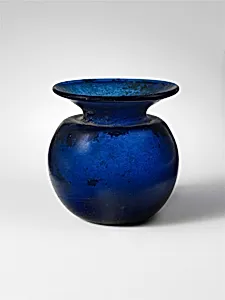
Glass jar
Unknown Artist
ca. 3rd–4th century CE
Medium
Glass
Dimensions
H.: 3 3/8 x 3 5/16 x 3 1/8 in. (8.6 x 8.4 x 7.9 cm)
Classification
Glass
Culture & Period
Roman · Late Imperial
Department
Greek and Roman Art
Museum
Metropolitan Museum of Art, New York, NY
Credit
Gift of Henry G. Marquand, 1881
Accession Number
81.10.117
Rights
Public Domain
Art Historical Context
This delicate glass jar, dating to the 3rd–4th CE, hails from the Late Imperial Roman period—a time of political upheaval and cultural transformation in the vast Roman Empire. Standing just over 3 inches tall, its modest dimensions (8.6 x 8.4 x 7.9 cm) made it perfectly suited for everyday use, as a container for oils, cosmetics, or spices in a household setting. Crafted by an unknown artisan, it exemplifies the Romans' mastery of glass production which revolutionized daily life after the invention of glassblowing around the 1st century BCE. Roman glassmakers employed free-blowing techniques, shaping molten glass over a blowpipe to create thin-walled, lightweight vessels like this one. By the Late Imperial era, glass had evolved from a luxury import to an affordable staple, mass-produced in workshops across the empire from Syria to Gaul. This jar's survival highlights the material's durability and the skill of ancient craftsmen, who achieved remarkable transparency and form without modern tools. Today, housed in the Metropolitan Museum of Art's Greek and Roman Art department (gift of Henry G. Marquand, 1881), it offers a tangible glimpse into Roman domestic culture. Such vessels bridged the gap between utility and artistry, reflecting an empire where even simple objects embodied ingenuity and widespread trade networks.