
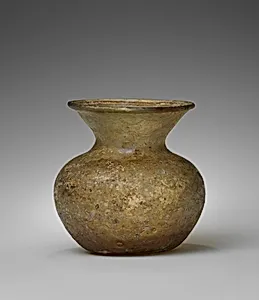
Glass jar
Unknown Artist
3rd century CE
Medium
Glass
Dimensions
H.: 2 11/16 in. (6.8 cm)
Classification
Glass
Culture & Period
Roman · Late Imperial
Department
Greek and Roman Art
Museum
Metropolitan Museum of Art, New York, NY
Credit
Bequest of Mary Anna Palmer Draper, 1915
Accession Number
15.43.228
Rights
Public Domain
Art Historical Context
This delicate glass jar, dating to the 3rd century CE, hails from the Late Imperial Roman period—a time when the vast empire faced internal strife yet maintained remarkable artistic continuity. Standing just 2 11/16 inches (6.8 cm) tall, this petite vessel exemplifies the everyday elegance of Roman craftsmanship, likely used for storing precious oils, perfumes, or medicinals in a household setting. Its unassuming form belies the sophistication of Roman glass production, which had evolved from earlier mold-blown techniques to freer forms by this era. Crafted entirely of glass, the jar highlights one of Rome's greatest contributions to material culture: the mastery of transparent, colorful glassblowing. Introduced centuries earlier, this medium allowed for lightweight, durable containers that ranged from utilitarian to luxurious, democratizing beauty and functionality across social classes. The jar's survival into modern times speaks to glass's resilience and the period's trade networks, which distributed such items empire-wide. Now part of the Metropolitan Museum of Art's Greek and Roman Art Department, thanks to the 1915 bequest of Mary Anna Palmer Draper, this anonymous treasure invites us to ponder the intimate lives of Romans. It reminds visitors that even small artifacts carry the weight of a civilization's ingenuity and daily rituals.