
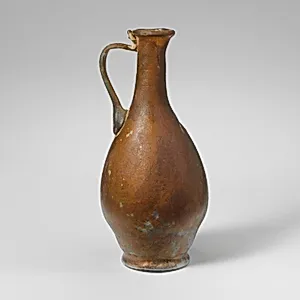
Glass jug
Unknown Artist
1st century CE
Medium
Glass
Dimensions
4 5/8 in. (11.8 cm) Other: 2 3/16 in. (5.5 cm) Diam. of rim: 7/8 in. (2.3 cm) Diam. of foot: 1 3/8 in. (3.5 cm)
Classification
Glass
Culture & Period
Roman · Early Imperial
Department
Greek and Roman Art
Museum
Metropolitan Museum of Art, New York, NY
Credit
The Cesnola Collection, Purchased by subscription, 1874–76
Accession Number
74.51.119
Rights
Public Domain
Art Historical Context
This delicate glass jug, crafted by an unknown Roman artisan in the 1st century CE during the Early Imperial period, exemplifies the everyday elegance of ancient Roman craftsmanship. Standing just 4 5/8 inches (11.8 cm) tall with a slender profile—rim diameter of 7/8 inch (2.3 cm) and foot diameter of 1 3/8 inches (3.5 cm)—it was likely designed for pouring small quantities of wine, oil, or perfume at the table or in personal rituals. Roman glassmaking reached a pinnacle in this era, with the invention of glassblowing around the mid-1st century BCE enabling the production of thin-walled, lightweight vessels like this one. Previously, glass objects were laboriously molded or cast; blowing allowed for affordable, mass-produced luxury items that graced households across the empire. Its transparent, iridescent quality, achieved through natural weathering over millennia, highlights both technical innovation and the material's enduring beauty. Acquired as part of The Cesnola Collection (purchased by subscription, 1874–76) and now housed in the Metropolitan Museum of Art's Greek and Roman Art Department, this jug offers a tangible glimpse into Roman domestic life, bridging the gap between elite artistry and daily utility in a thriving imperial culture.