
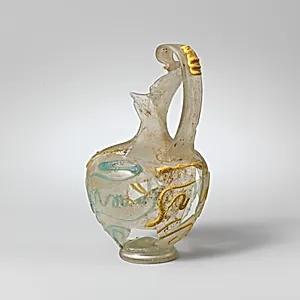
Glass jug with snake-thread decoration
Unknown Artist
late 2nd–3rd century CE
Medium
Glass
Dimensions
H. with handle 5 3/8 in. (13.6 cm)
Classification
Glass
Culture & Period
Roman, Rhenish · Mid Imperial
Department
Greek and Roman Art
Museum
Metropolitan Museum of Art, New York, NY
Credit
Fletcher Fund, 1959
Accession Number
59.11.12
Rights
Public Domain
Art Historical Context
This delicate glass jug, adorned with intricate snake-thread decoration, h from the Rhenish region of the Roman Empire during the late 2nd to 3rd century CE, a time of Mid Imperial prosperity. Standing just 5 3/8 inches tall with its handle, this small vessel exemplifies the everyday elegance of Roman tableware. Produced in workshops along the Rhine—likely near modern-day Cologne—it reflects the cultural fusion of Roman innovation and local craftsmanship in a frontier province bustling with trade and military activity. The standout feature is its "snake-thread" technique, where molten glass threads were trailed onto the still-hot surface in sinuous, serpentine patterns during the blowing process. This method, mastered by Rhenish glassmakers, created dynamic, almost animated designs that catch the light beautifully, turning a functional jug into a work of art. Such decoration wasn't just aesthetic; it showcased technical virtuosity, as the threads had to be applied precisely to avoid cracking the delicate body. On display in the Metropolitan Museum of Art's Greek and Roman Art department (acquired via the Fletcher Fund in 1959), this jug offers a glimpse into Roman daily life—perhaps holding wine or oil at a provincial banquet. Its survival highlights glass's durability and the era's advanced manufacturing, reminding us how ordinary objects carried profound artistic flair.