
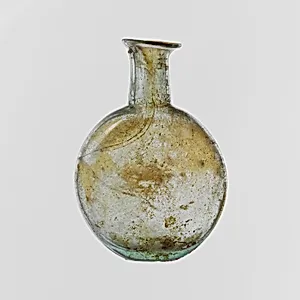
Glass lentoid bottle
Unknown Artist
2nd–3rd century CE
Medium
Glass
Dimensions
3 in. (7.6 cm) Diam. of rim: 13/16 in. (2.1 cm) Width: 2 1/16 in. (5.2 cm)
Classification
Glass
Culture & Period
Roman · Mid Imperial
Department
Greek and Roman Art
Museum
Metropolitan Museum of Art, New York, NY
Credit
The Cesnola Collection, Purchased by subscription, 1874–76
Accession Number
74.51.68
Rights
Public Domain
Art Historical Context
This delicate glass lentoid bottle, dating to the 2nd–3rd century CE, exemplifies the refined artistry of Mid Imperial Roman glassmaking. Shaped like a lentil—biconvex with a narrow rim (just 13/16 inch or 2.1 cm in diameter)—it stands a modest 3 inches (7.6 cm) tall and 2 1/16 inches (5.2 cm) wide, making it perfectly portable for everyday use. Likely crafted for holding perfumes, oils, or cosmetics, such vessels were common in Roman households, blending functionality with subtle elegance. Roman glassworkers, building on innovations like free-blowing introduced in the 1st century BCE, produced these items in vibrant workshops across the empire, from Italy to the eastern provinces. The transparent or lightly colored glass here highlights their mastery of transparency and form, achieved through careful heating and shaping in molds or freehand. Translucent vessels like this symbolized luxury accessible to the middle classes, reflecting Rome's expansive trade networks that distributed raw materials like silica sand and natron. Acquired as part of The Cesnola Collection (purchased by subscription, 1874–76) at The Metropolitan Museum of Art, this bottle offers a glimpse into intimate Roman life. Its survival underscores the durability of glass, a material that revolutionized storage and display in antiquity.