
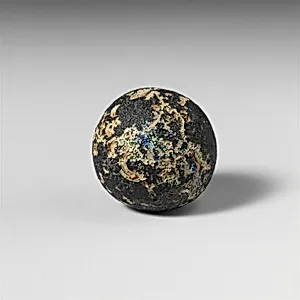
Glass marble
Unknown Artist
1st–4th century CE
Medium
Glass
Dimensions
Diam.: 1 in. (2.5 cm)
Classification
Glass
Culture & Period
Roman · Imperial
Department
Greek and Roman Art
Museum
Metropolitan Museum of Art, New York, NY
Credit
The Cesnola Collection, Purchased by subscription, 1874–76
Accession Number
74.51.328
Rights
Public Domain
Art Historical Context
This exquisite glass marble, dating to the Roman Imperial period (1st4th century CE), the everyday artistry of ancient Rome. Measuring just 1 inch (2.5 cm) in diameter, its perfectly spherical form captures the ingenuity of Roman glassmakers, who transformed humble silica into durable, translucent treasures. Likely used in children's games or as gaming pieces—much like modern marbles—it reflects the leisure pursuits of Roman society, from humble households to elite villas. Roman glass production reached its zenith during the Imperial era, with techniques like molding and core-forming allowing for mass production of small objects like this one. Translucent and brilliantly colored (though specifics vary), such marbles highlight the empire's advanced craftsmanship, fueled by trade networks spanning the Mediterranean. Acquired as part of the Cesnola Collection from Cyprus excavations and purchased by subscription in 1874–76, it now resides in The Metropolitan Museum of Art's Greek and Roman Art department. Though unassuming, this marble offers a window into Roman daily life, where even toys embodied technical mastery. Its survival over 1,700 years reminds us of the enduring appeal of simple, skillful design.