
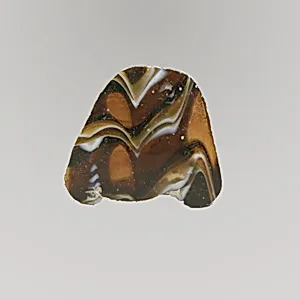
Glass mosaic bowl fragment
Unknown Artist
late 1st century BCE–early 1st century CE
Medium
Glass
Dimensions
H.: 1 3/8 x 1 1/2 in. (3.5 x 3.8 cm)
Classification
Glass
Culture & Period
Roman · Early Imperial
Department
Greek and Roman Art
Museum
Metropolitan Museum of Art, New York, NY
Credit
Edward C. Moore Collection, Bequest of Edward C. Moore, 1891
Accession Number
91.1.1738
Rights
Public Domain
Art Historical Context
This delicate glass mosaic bowl fragment, to the late 1st century BCE through early 1st century, offers a glimpse into the opulent world of Early Imperial Rome. Measuring just 1 3/8 x 1 1/2 inches (3.5 x 3.8 cm), it once formed part of a larger vessel, likely used for dining or display among the elite. Crafted during the transition from Republic to Empire under Augustus, such pieces reflect Rome's growing mastery of glass, blending functionality with lavish decoration. The mosaic technique—creating intricate patterns by fusing colored glass rods and slicing them into cross-sections—produced vibrant, gem-like effects that mimicked semiprecious stones. This innovation elevated glass from everyday material to luxury good, showcasing Roman ingenuity in mass-producing beauty. Though the full design is lost, the fragment's preservation highlights the durability of these artifacts, which traveled widely through trade networks across the Mediterranean. Now housed in the Metropolitan Museum of Art's Greek and Roman Art Department, this piece entered the collection via the Edward C. Moore bequest in 1891. It invites us to ponder the artistry of anonymous craftsmen whose work adorned Roman tables, bridging ancient innovation with our modern appreciation for classical elegance.