
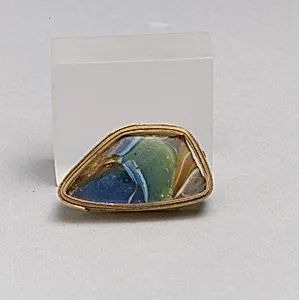
Glass mosaic bowl fragment
Unknown Artist
late 1st century BCE–early 1st century CE
Medium
Glass
Dimensions
Other: 5/8 x 1 3/16 in. (1.6 x 3.1 cm)
Classification
Glass
Culture & Period
Roman · Early Imperial
Department
Greek and Roman Art
Museum
Metropolitan Museum of Art, New York, NY
Credit
Edward C. Moore Collection, Bequest of Edward C. Moore, 1891
Accession Number
91.1.1916
Rights
Public Domain
Art Historical Context
This delicate fragment from a glass mosaic bowl offers a glimpse into the opulent world of Early Imperial Rome, dating to the late 1st century BCE the early 1st CE. Crafted during reign of Augustus and his successors, when Rome transitioned from republic to empire, such luxury glassware symbolized wealth and refined taste among the elite. Though only a small piece measuring 5/8 x 1 3/16 inches (1.6 x 3.1 cm), it hints at the vibrant, patterned designs that once adorned entire vessels used for dining or display. Roman glassmakers excelled in the intricate mosaic technique, fusing slender canes of colored glass—often in vivid blues, whites, and reds—then slicing them crosswise to create intricate motifs like florals or geometrics. This labor-intensive method, perfected in Italy and the eastern Mediterranean, elevated glass from everyday material to high art, rivaling precious metals. Surviving fragments like this one underscore the fragility and rarity of these objects, most lost to time. Acquired through the Edward C. Moore Collection and now housed in the Metropolitan Museum of Art's Greek and Roman Art department, this piece invites us to marvel at ancient innovation. Up close, it reveals the precision of Roman artisans, bridging the practical and the beautiful in everyday luxury.