
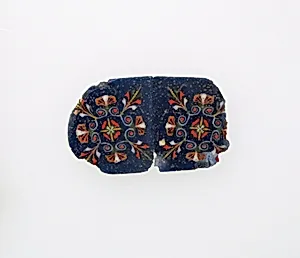
Glass mosaic inlay
Unknown Artist
late 1st century BCE–1st century CE
Medium
Glass
Dimensions
H.: 1 3/8 in. (3.5 cm)
Classification
Glass
Culture & Period
Roman · Hellenistic
Department
Greek and Roman Art
Museum
Metropolitan Museum of Art, New York, NY
Credit
Gift of J. Pierpont Morgan, 1917
Accession Number
17.194.379
Rights
Public Domain
Tags
Art Historical Context
This exquisite glass mosaic inlay, dating to the late 1st century BCE the 1st century, exemplifies the refined artistry of the Hellenistic period under Roman influence. Measuring just 1 3/8 inches (3.5 cm) in height, this tiny treasure features delicate palmette motifs—stylized palm leaves that evoke growth and vitality, a hallmark of classical decoration seen in architecture, pottery, and jewelry. Crafted by an unknown Roman artist, it likely served as an inlay for luxury furniture, vessels, or personal adornments, highlighting the era's blend of Greek aesthetic elegance and Roman technical prowess. Glass mosaics like this one showcase advanced ancient techniques: artisans fused colorful glass rods or canes, sliced them into thin sections, and arranged them into intricate patterns before firing. This method produced vibrant, durable designs that mimicked more precious materials like gemstones, making opulence accessible to the elite. In the Hellenistic world, such objects symbolized cultural sophistication amid expanding trade networks, from Alexandria to Rome. Today, housed in the Metropolitan Museum of Art's Greek and Roman Art Department (gift of J. Pierpont Morgan, 1917), this inlay invites us to marvel at the ingenuity of everyday ancients—reminding visitors that beauty often thrives in the smallest details.