
Glass network mosaic fragment
Unknown Artist
late 1st century BCE–early 1st century CE
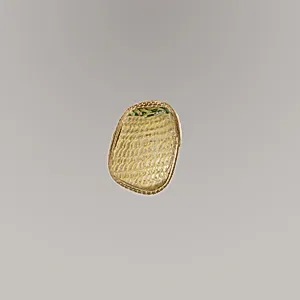
Medium
Glass
Dimensions
Other: 13/16 x 1 3/16 in. (2.1 x 3 cm)
Classification
Glass
Culture & Period
Roman · Early Imperial
Department
Greek and Roman Art
Museum
Metropolitan Museum of Art, New York, NY
Credit
Edward C. Moore Collection, Bequest of Edward C. Moore, 1891
Accession Number
91.1.1757
Rights
Public Domain
Art Historical Context
This delicate *Glass Network Mosaic Fragment* hails from the Early Imperial Roman period (late 1st century BCE early 1st century CE), a time when Rome's artistic prowess flourished under Augustus and his successors. Measuring just 13/16 x 1 3/16 inches (2.1 x 3 cm), this tiny piece is a survivor from a larger mosaic, likely part of a luxury vessel or decorative panel. Part of the Metropolitan Museum of Art's Greek Roman Art collection, it entered via the Edward C. Moore in 1891, showcasing the era's fascination with opulent glasswork. Crafted from intricately arranged glass rods or canes—fused and sliced to create a repeating "network" or net-like pattern—this fragment exemplifies Roman innovation in glassmaking. Artisans heated colorful glass rods, twisted them into complex designs, and embedded them in a clear matrix before cutting thin slices for mosaics. Such techniques produced mesmerizing, jewel-like effects that mimicked more precious materials like gemstones, reserved for elite homes and banquets. Though small, this artifact reveals the cultural sophistication of early Imperial Rome, where glass transitioned from everyday utility to high art. Imagine it sparkling under oil lamps, a testament to the empire's technical mastery and love for geometric elegance—bridging utility and beauty in the ancient world.