
Glass Panel
1763–74
Medium
Free-blown glass
Dimensions
5 5/8 x 8 1/4 in. (14.3 x 21 cm)
Classification
Glass panel
Culture
American
Department
The American Wing
Museum
Metropolitan Museum of Art, New York, NY
Credit
Gift of Frederick W. Hunter, 1913
Accession Number
13.223.3
Rights
Public Domain
Art Historical Context
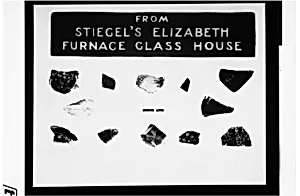
This delicate *Glass Panel*, crafted at Stiegel's Elizabeth Furnace 1763 and 1774, exemplifies early American ingenuity in glassmaking. Produced during the colonial era, when the American colonies were striving for industrial independence from European imports, it hails from the workshop of Henry William Stiegel a pioneering German immigrant entrepreneur. His Elizabeth Furnace in Manheim, Pennsylvania, among the first to manufacture high-quality flint glass on U.S. soil, marking a pivotal moment in the nation's decorative arts. The panel's medium—free-blown glass—highlights masterful traditional techniques. In free-blowing, molten glass is gathered on a blowpipe and shaped solely by the artisan's breath and tools, without molds, yielding fluid, organic forms. At just 5⅝ × 8¼ inches (14.3 × 21 cm), this petite piece was likely intended for architectural or domestic use, such as a window inset or lantern panel, showcasing the transparency and subtle color variations prized in 18th-century glasswork. Now housed in The Metropolitan Museum of Art's American Wing as a 1913 gift from Frederick W. Hunter, the panel stands as a tangible link to America's pre-Revolutionary craft heritage. It invites visitors to appreciate how such objects blended European influences with emerging American identity, fostering self-reliance in the arts.