
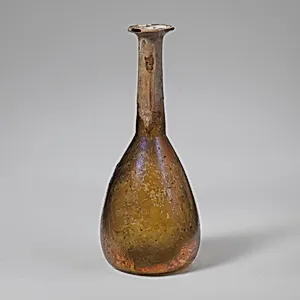
Glass perfume bottle
Unknown Artist
1st century CE
Medium
Glass
Dimensions
4 15/16in. (12.5cm) Other: 2 1/16 in. (5.2 cm) Diam. of rim: 15/16 in. (2.4 cm)
Classification
Glass
Culture & Period
Roman · Early Imperial
Department
Greek and Roman Art
Museum
Metropolitan Museum of Art, New York, NY
Credit
The Cesnola Collection, Purchased by subscription, 1874–76
Accession Number
74.51.38
Rights
Public Domain
Art Historical Context
This delicate glass perfume bottle, dating to the 1st century CE during Rome's Early Imperial period, offers a glimpse into the everyday luxuries of ancient Roman life. Standing just under 5 inches tall with a slender profile—4 15/16 inches high, 2 1/ inches wide, and a rim diameter of 15/16 inches—it was designed for portability, perfect for carrying scented oils or perfumes used in grooming, rituals, or social display. Crafted by an unknown artisan, its small scale and graceful form highlight the Romans' mastery of glass as a versatile medium for both functional and elegant objects. Glassmaking flourished in the Roman world during this era, evolving from earlier techniques into more refined production methods that allowed for thin, transparent vessels like this one. Perfume bottles were common household items, reflecting the culture's emphasis on hygiene, beauty, and sensory pleasures—aromas from imported essences like rose or myrrh wafted through homes and public baths. Part of The Cesnola Collection at The Metropolitan Museum of Art's Department of Greek and Roman Art, acquired through public subscription in 1874–76, this piece connects us to the vibrant trade networks of the Mediterranean, where such wares were prized possessions. Though simple in design, its survival underscores the durability of Roman glass craftsmanship, inviting us to ponder the hands that once held it.