
Glass perfume bottle
Unknown Artist
2nd–3rd century CE
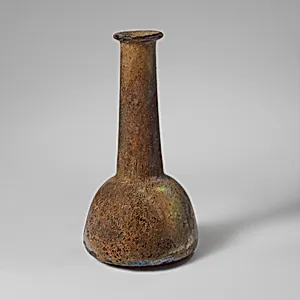
Medium
Glass
Dimensions
5 5/16in. (13.5cm) Other: 2 11/16 in. (6.9 cm) Diam. of rim: 1 1/8 in. (2.9 cm)
Classification
Glass
Culture & Period
Roman · Mid Imperial
Department
Greek and Roman Art
Museum
Metropolitan Museum of Art, New York, NY
Credit
The Cesnola Collection, Purchased by subscription, 1874–76
Accession Number
74.51.100
Rights
Public Domain
Art Historical Context
This delicate glass perfume bottle, dating to the 2nd–3rd century CE, hails from the Roman Mid-Imperial period and exemplifies the everyday elegance of ancient Roman life. Standing just 5 5/16 inches (13.5 cm) tall with a slender profile—2 11/16 inches (6.9 cm) wide and a rim diameter of 1 1/8 inches (2.9 cm)—it was likely used to hold scented oils or perfumes, essential for personal grooming, religious rituals, or as luxurious gifts. Such vessels, known as unguentaria, were ubiquitous in Roman households, reflecting the empire's sophisticated culture of beauty and hygiene. Crafted from glass, a medium revolutionized by Roman innovations like glassblowing around the 1st century BCE, this bottle showcases the era's technical prowess. Free-blown glass allowed for affordable, mass-produced forms in vibrant colors and shapes, democratizing luxury items once reserved for the elite. Its simple, elongated shape with a narrow neck highlights practical design for easy pouring and storage, while the transparency preserved the allure of the fragrant contents within. Acquired as part of The Cesnola Collection (purchased by subscription, 1874–76) and now housed in the Metropolitan Museum of Art's Greek and Roman Art Department, this unassuming artifact offers a tangible glimpse into Roman daily rituals and the artistry of anonymity. It reminds us how small objects can illuminate the sensory world of antiquity.