
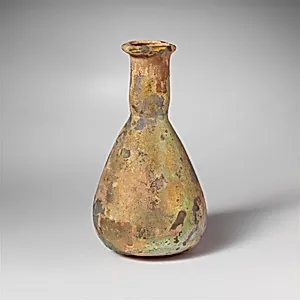
Glass perfume bottle
Unknown Artist
1st century CE
Medium
Glass
Dimensions
Overall: 3 1/4in. (8.3cm) Diam.: 1 13/16 x 7/8 in. (4.6 x 2.2 cm)
Classification
Glass
Culture & Period
Roman · Early Imperial
Department
Greek and Roman Art
Museum
Metropolitan Museum of Art, New York, NY
Credit
The Cesnola Collection, Purchased by subscription, 1874–76
Accession Number
74.51.5764
Rights
Public Domain
Art Historical Context
This delicate glass perfume bottle, dating to the 1st century CE Rome's Early Imperial period, the everyday elegance of ancient Roman life. Standing just 3 1/4 inches tall with a slender diameter of about 1 13/16 by 7/8 inches, it likely used to hold fragrant oils, perfumes, or cosmetics—essentials for personal grooming, social rituals, and even funerary offerings. Its petite, elongated form, known as an unguentarium, was designed for easy handling and precise dispensing, reflecting the practical beauty prized in Roman households. Roman glassmaking reached new heights in this era, with innovations like free-blowing (perfected around 50 BCE) making such vessels affordable and ubiquitous. Translucent and lightweight, this bottle would have shimmered in the light, showcasing the craft's technical prowess without ostentation. Glass objects like this democratized luxury, appearing in tombs across the empire from Britain to Egypt, hinting at widespread trade and cultural exchange. Acquired as part of The Cesnola Collection at The Metropolitan Museum of Art in 1874–76, this unassuming treasure offers a window into the sensory world of imperial Rome—where scent was as vital as sight. Visitors, pause to imagine its faint aroma lingering through millennia!