
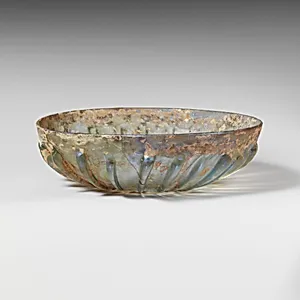
Glass ribbed bowl
Unknown Artist
late 1st century BCE–mid 1st century CE
Medium
Glass
Dimensions
H.: 1 3/4 in. (4.4 cm) Diam.: 5 7/8 in. (14.9 cm)
Classification
Glass
Culture & Period
Roman · Early Imperial
Department
Greek and Roman Art
Museum
Metropolitan Museum of Art, New York, NY
Credit
The Cesnola Collection, Purchased by subscription, 1874–76
Accession Number
74.51.289
Rights
Public Domain
Art Historical Context
This delicate glass ribbed bowl, crafted by an unknown Roman artisan during the late 1st century BCE to mid-1st century CE, exemplifies the Early Imperial period's innovative glassworking. Standing just 1¾ inches tall with a diameter of 5⅞ inches, its subtle ribbed texture—formed by pressing molten glass into a mold—creates a play of light and shadow, enhancing both its aesthetic appeal and practicality for holding small offerings, perfumes, or confections. Roman glass production flourished around this time, transitioning from costly luxury imports to more accessible wares thanks to advances in mold-forming and early blowing techniques. Such bowls were everyday treasures in households across the Empire, from Italy to the eastern provinces like Cyprus, where this piece likely originated as part of The Cesnola Collection acquired by the Metropolitan Museum of Art in 1874–76. They reflect Rome's blend of functionality and subtle elegance, bridging Hellenistic traditions with imperial prosperity. Today, this unassuming vessel invites us to marvel at ancient ingenuity: a fragile survivor that once graced a Roman table, whispering of a world where glass democratized beauty.