
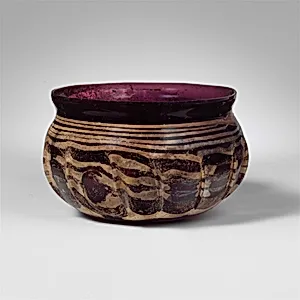
Glass ribbed bowl
Unknown Artist
mid-1st century CE
Medium
Glass
Dimensions
H.: 2 9/16 in. (6.5 cm) Diam.: 3 5/8 in. (9.2 cm)
Classification
Glass
Culture & Period
Roman · Early Imperial
Department
Greek and Roman Art
Museum
Metropolitan Museum of Art, New York, NY
Credit
Edward C. Moore Collection, Bequest of Edward C. Moore, 1891
Accession Number
91.1.1268
Rights
Public Domain
Art Historical Context
This delicate glass ribbed bowl, by an unknown Roman artisan in the mid-1st century CE during the Early Imperial period, exemplifies the era's remarkable advancements in glassmaking. Standing just 2 9/16 inches tall and 3 5/8 inches in diameter its petite size made it ideal for serving olives, sweets, or small portions at elite banquets, blending everyday utility with subtle elegance. The ribbed surface—created through innovative mold-blowing techniques—produces a textured, fluted effect that catches the light, highlighting the transparency and clarity of Roman glass, a material prized for its versatility and affordability compared to luxury metals. Roman glass production exploded in the 1st century CE, thanks to the invention of glassblowing around 50 BCE, which allowed for rapid, intricate designs like these ribs. Such bowls were widely exported across the Empire, from Italy to Britain, symbolizing cultural sophistication and economic prosperity under emperors like Claudius and Nero. This piece reflects how glass transitioned from elite imports to commonplace treasures, democratizing beauty in Roman households. Now part of the Metropolitan Museum of Art's Greek and Roman Art collection, gifted through the Edward C. Moore bequest in 1891, it offers a tangible glimpse into imperial daily life—inviting us to imagine the flicker of oil lamps dancing across its shimmering ribs.