
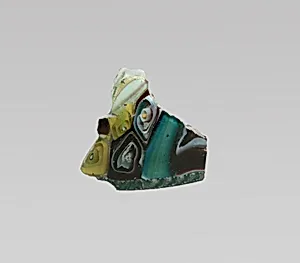
Glass short-strip mosaic bowl fragment
Unknown Artist
late 1st century BCE–early 1st century CE
Medium
Glass
Dimensions
Other: 1 3/16 x 1 3/16 in. (3.1 x 3.1 cm); estimated diam. of rim 3 9/16 in. (9 cm)
Classification
Glass
Culture & Period
Roman · Early Imperial
Department
Greek and Roman Art
Museum
Metropolitan Museum of Art, New York, NY
Credit
Edward C. Moore Collection, Bequest of Edward C. Moore, 1891
Accession Number
91.1.1836
Rights
Public Domain
Art Historical Context
This delicate fragment from a glass short-strip mosaic bowl offers a glimpse into the opulent world of Early Imperial Rome, dating to the late 1st century through the early 1st CE. Crafted during reign of Augustus and his successors, when the Roman Empire was expanding its cultural and economic reach, such vessels were luxury items reserved for the elite. Produced in workshops likely in Italy or the eastern Mediterranean, they exemplify the height of pre-glassblowing technology, showcasing Rome's mastery over vibrant, multicolored glass. The "short-strip mosaic" technique involved creating thin slices or strips of colored glass canes—rods fused with patterns inside—and arranging them into intricate designs before fusing them in a mold and casing them in a clear glass overlay. This fragment, measuring just 1 3/16 inches square with an estimated rim diameter of 3 9/16 inches, hints at the bowl's original floral or geometric motifs, which mimicked costly stone mosaics or cameos. These bowls were prized for their jewel-like translucency and durability, symbols of wealth traded across the empire. Now part of the Metropolitan Museum of Art's Greek and Roman Art collection, gifted through the Edward C. Moore bequest in 1891, this piece invites us to marvel at ancient artisans' precision and imagination, bridging everyday utility with artistic splendor.