
Glass square bottle
Unknown Artist
2nd–3rd century CE
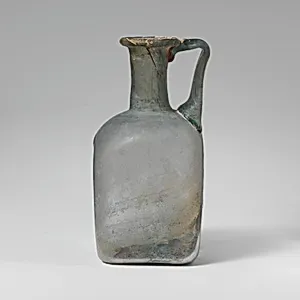
Medium
Glass
Dimensions
4 15/16 in. (12.5 cm) Other: 3 1/4 in. (8.3 cm) Diam. of rim: 1 5/16 in. (3.4 cm)
Classification
Glass
Culture & Period
Roman · Mid Imperial
Department
Greek and Roman Art
Museum
Metropolitan Museum of Art, New York, NY
Credit
The Cesnola Collection, Purchased by subscription, 1874–76
Accession Number
74.51.109
Rights
Public Domain
Art Historical Context
This delicate glass square bottle, dating to the 2nd–3rd century CE, exemplifies the refined craftsmanship of Mid Imperial Rome. Standing just under 5 inches (12.5 cm) tall with a narrow rim diameter of 1 5/16 inches (3.4 cm), its geometric form—practical yet elegantly proportioned—reflects the Romans' mastery of glass production. Likely free-blown or molded, such vessels were everyday luxuries, showcasing the era's innovative techniques that made glass affordable and ubiquitous across the empire. In the bustling Roman world, glass objects like this bottle served functional roles, possibly for oils, perfumes, or medicinals, while doubling as symbols of cultural sophistication. The Mid Imperial period marked a peak in glassmaking innovation, with vibrant colors and precise shapes produced in workshops from Italy to the eastern provinces. Its square profile, less common than rounded forms, highlights artistic experimentation in form and utility. Acquired as part of The Cesnola Collection (purchased by subscription, 1874–76) and now housed in the Metropolitan Museum of Art's Greek and Roman Art Department, this unassuming treasure invites us to appreciate the anonymous artisans who transformed sand into enduring beauty, bridging ancient daily life with modern wonder.