
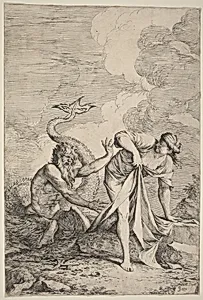
Glaucus and Scylla
1615-1673
Medium
etching
Dimensions
overall: 34.3 x 23.2 cm (13 1/2 x 9 1/8 in.)
Classification
Department
CG-E
Museum
National Gallery of Art, Washington, D.C.
Credit
Ailsa Mellon Bruce Fund
Accession Number
1972.66.41
Rights
Public Domain
Art Historical Context
Step into the dramatic world of Salvator Rosa's *Glaucus and Scylla*, a captivating etching from the mid-17th century. The Italian artist (1615–1673), a key figure in the Baroque period, draws from classical mythology: Glaucus, a mortal fisherman transformed into a sea god, desperately pursues the beautiful nymph Scylla, whose fate would later turn tragic through sorcery. Rosa's composition pulses with raw emotion and movement, embodying his signature "wild" style—often called proto-Romantic for its rugged energy and departure from the polished classicism of his peers. As a master etcher, Rosa elevated printmaking beyond mere reproduction, using the medium's fine lines and tonal contrasts to evoke tenebrism's dramatic chiaroscuro, much like his oil paintings of tempests and battles. Etchings like this one, measuring 34.3 × 23.2 cm, were prized for their affordability and portability, spreading Baroque intensity to collectors across Europe. This rarity highlights Rosa's technical virtuosity, where acid bites into copper plates to create intricate textures of waves, hair, and divine fervor. Housed in the National Gallery of Art's Department of Prints (CG-E) through the Ailsa Mellon Bruce Fund, *Glaucus and Scylla* invites us to ponder eternal themes of unrequited love and transformation, bridging ancient myths with 17th-century artistic innovation. A testament to Rosa's rebellious spirit!
About the Artist
Salvator Rosa · 1615–1673
Salvator Rosa was born in 1615 in Arenella, on the outskirts of Naples, into a world of artistic ambition and turbulent talent. His early training came through his maternal uncle, the painter Paolo Greco, and his brother-in-law Francesco Fracanzano, himself a pupil of the great Spanish-born Neapolitan master Jusepe de Ribera. Rosa showed a fierce independence from the start, resisting his father's...