
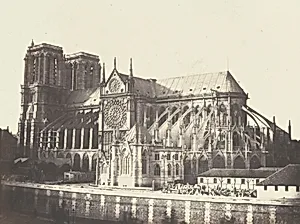
Église Notre Dame - Côté sud
Medium
salted paper print
Dimensions
image/sheet: 16.2 × 21.7 cm (6 3/8 × 8 9/16 in.) mount: 33.1 × 42.7 cm (13 1/16 × 16 13/16 in.)
Classification
Photograph
Department
CPH
Museum
National Gallery of Art, Washington, D.C.
Credit
Clinton and Jean Wright Fund
Accession Number
2020.55.1
Rights
Public Domain
Art Historical Context
Step into the luminous world of early photography with François-Auguste Renard's *Église Notre Dame - C sud* (1852), a delicate salted paper print capturing the south facade of Paris's Notre-Dame Cathedral. This .2 × 21.7 cm image, on a larger 33.1 × 42.7 cm sheet, showcases the Gothic splendor of the 12th-14th century landmark—its flying buttresses, rose window, and intricate stonework rendered with a soft, warm glow characteristic of the era. Created just a decade after the invention of photography, Renard's work exemplifies the salted paper process pioneered by William Henry Fox Talbot. Light-sensitive silver salts fixed to paper produced detailed, matte-toned prints directly from a negative, ideal for architectural documentation. In 1852, as France embraced calotype techniques, photographers like Renard preserved vanishing medieval heritage with unprecedented precision, bridging art and science. Housed in the National Gallery of Art's photography department through the Clinton and Jean Wright Fund, this print invites us to marvel at Notre-Dame's timeless elegance before modern restorations—or tragedies—altered its profile, offering a poignant glimpse into 19th-century visual innovation.