
Globular Beads with Caps, Strung as a Necklace
Unknown Artist
ca. 1648–1540 B.C.
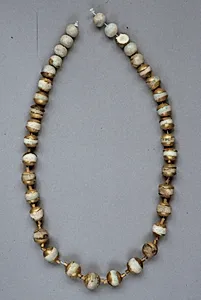
Medium
Faience, gold Gold
Dimensions
necklace: l. 38.4 cm (15 1/8 in) each element: l. 2.1 cm (13/16 in); diam. 1.3 cm (1/2 in)
Classification
Beads, ball
Period
Second Intermediate Period
Department
Egyptian Art
Museum
Metropolitan Museum of Art, New York, NY
Credit
Purchase, Lila Acheson Wallace Gift, 1968
Accession Number
68.136.26
Rights
Public Domain
Art Historical Context
Step into ancient Egypt's Second Intermediate Period (ca. 1648–1540 B.C.), a time of political flux when the Hyksos rulers of Dynasty 15 held sway in the north. This exquisite necklace, *Globular Beads with, Strung as aklace*, captures the era's enduring love for personal adornment. Measuring 38.4 cm long, it features uniform globular beads—each about 2.1 cm long and 1.3 cm in diameter—crafted with precision, evoking the craftsmanship of elite workshops. Made of vibrant faience, a glazed ceramic prized for its brilliant turquoise hue that mimicked rare lapis lazuli, the beads are capped with gleaming gold, blending affordability with opulence. Faience's glassy frit allowed for durable, colorful jewelry accessible to the upper class, while gold symbolized eternity and divine favor. Strung together, these elements formed a versatile piece likely worn for status, protection, or ritual. Acquired by the Metropolitan Museum of Art in 1968 through the Lila Acheson Wallace Gift, this necklace offers a tangible link to daily life and beliefs in a turbulent age, reminding us how ancient Egyptians adorned themselves with beauty amid change.