
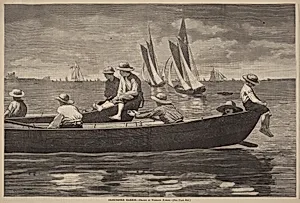
Gloucester Harbor
published 1873
Medium
wood engraving
Classification
Department
CG-W
Museum
National Gallery of Art, Washington, D.C.
Credit
Print Purchase Fund (Rosenwald Collection)
Accession Number
1958.3.5
Rights
Public Domain
Art Historical Context
**Gloucester Harbor**, a wood engraving published in 3 after Winslow Homer, captures the beauty and daily life of a quintessential New England fishing port. Homer, a leading American realist painter (1836–1910), was renowned for his vivid depictions of maritime scenes, often highlighting the stoic fishermen and turbulent seas that defined coastal America. This print reproduces one of his compositions from Gloucester, Massachusetts—a bustling harbor town central to the 19th-century fishing industryevoking the era's blend of natural drama and human endeavor. Wood engraving, the medium here, was a hallmark of Victorian-era printmaking, allowing intricate details to be carved into end-grain wood blocks for sharp, high-contrast reproductions. Popular in magazines like *Harper's Weekly*, where Homer frequently contributed, these prints democratized art, bringing his masterful realism to a wide audience beyond oil paintings or watercolors. The technique's precision enhances Homer's characteristic play of light on waves and sails, underscoring themes of labor and nature's power. Acquired through the Print Purchase Fund (Rosenwald Collection) at the National Gallery of Art, this work exemplifies how prints preserved Homer's influence during his lifetime. Visitors will appreciate its historical snapshot of post-Civil War America, where the sea both sustained and challenged communities. (198 words)
About the Artist
after Winslow Homer
"After Winslow Homer" is the conventional attribution in art historical catalogs for a body of mid- to late-19th-century wood engravings that reproduce the illustrations drawn by the eminent American realist painter Winslow Homer (1836–1910) for popular periodicals, most notably Harper's Weekly. Beginning in 1857, shortly after Harper's Weekly launched in New York, Homer contributed hundreds of sk...