
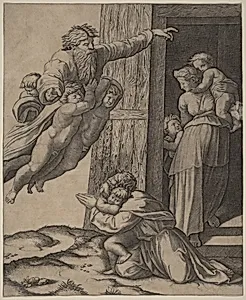
God Appearing to Noah
c. 1513-1515
Medium
engraving on laid paper
Dimensions
sheet (trimmed within platemark): 30.6 × 25 cm (12 1/16 × 9 13/16 in.)
Classification
Department
CG-E
Museum
National Gallery of Art, Washington, D.C.
Credit
Rosenwald Collection
Accession Number
1943.3.7346
Rights
Public Domain
Art Historical Context
In the National Gallery of Art's Rosenwald Collection, *God Appearing to Noah* is a masterful engraving Marcantonio Raimondi created around 1513-1515 after a design by the High Renaissance genius Raphael. This print captures pivotal biblical moment from Genesis, where God appears to Noah after the flood, likely symbolizing divine promise and renewal—often depicted with the rainbow covenant. Trimmed to 30.6 × 25 cm on laid paper, it exemplifies the intimate scale of early 16th-century prints, perfect for collectors and scholars. Raimondi, a pioneering Italian engraver, faithfully reproduced Raphael's fluid compositions, translating the painter's graceful figures and dramatic lighting into intricate lines etched into a copper plate. Engraving, an intaglio technique involving incised grooves filled with ink, allowed for exceptional detail and tonal depth, revolutionizing printmaking by making High Renaissance artistry widely accessible beyond paintings' elite patrons. This work highlights the era's cultural shift toward reproductive prints, bridging painting and mass dissemination. As Raphael's influence peaked in Rome under papal patronage, Raimondi's engravings spread his harmonious ideals across Europe, influencing generations of artists and underscoring prints' role in shaping Renaissance visual culture.