
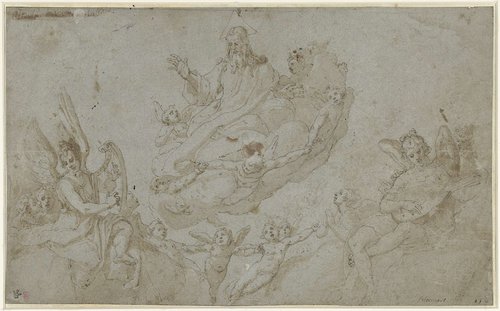
God de Vader met musicerende engelen
1560 - 1578
Medium
pen
Dimensions
407; 250
Rights
Public Domain
About this artwork
…; the dealer G. Ventura, Paris, possibly circa 1930-1939, L. 2501b;{Fondation Custodia, Marques de collection, entree L. 2501b.} …; anonymous sale, Paris (Drouot), 11 December 1937, no. 55, as Abraham Blomaert; OR …; anonymous sale, Paris (Drouot), 11 December 1937, no. 55, as Abraham Blomaert; …; the dealer G. Ventura, Paris, possibly circa 1930-1939, L. 2501b;{Fondation Custodia, Marques de collection, entree L. 2501b.} ...; the dealer J. Wiegersma, Utrecht, L. 1552b; …; acquired by the museu...
Art Historical Context
This delicate pen drawing by Raffaellino da Reggio captures the majestic figure of God the Father surrounded by music-making angels, a theme that resonated deeply in Renaissance religious art. Created between 1560 and 1578, the work reflects the artist’s training in the Mannerist tradition, where elongated forms and graceful movement conveyed spiritual elevation. As a pen study measuring 250 by 407 millimeters, it likely served as a preparatory sketch or independent devotional piece, showcasing the expressive potential of line work to suggest both divine authority and celestial harmony. Raffaellino, active in Rome and Reggio Emilia during a period of intense artistic patronage, contributed to the evolving language of Counter-Reformation imagery. Drawings like this one allowed artists to explore complex groupings of figures and symbolic motifs before committing them to larger paintings or frescoes. The presence of musical angels underscores the Renaissance belief in music as a bridge between heaven and earth, a motif frequently found in church decorations of the era. Acquired by the museum in 1940 after passing through notable European collections, the sheet offers modern viewers an intimate glimpse into the creative process of a gifted draftsman whose career was cut short at a young age. Its fine pen strokes continue to reward close looking, revealing both technical skill and quiet reverence.