
God the Father
ca. 1770–80
Medium
Pine, painted white
Dimensions
7 ft. 8 in. x 5 ft. 8-1/2 in. (233.5 x 174.5 cm.)
Classification
Sculpture
Culture
Southern German, Bavaria
Department
European Sculpture and Decorative Arts
Museum
Metropolitan Museum of Art, New York, NY
Credit
Fletcher Fund, 1964
Accession Number
64.239
Rights
Public Domain
Tags
Art Historical Context
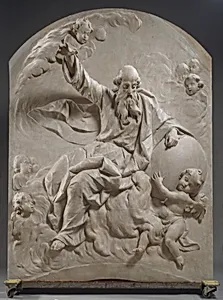
Ignaz Günther's *God the Father*, carved around 1770–80, stands as a majestic testament to Bavarian Rococo sculpture. This nearly eight-foot-tall figure, fashioned from pine and painted white, captures the patriarch in a dynamic pose, likely blessing or enthroned amid, embodying the era's fervent Catholic devotion. Günther, leading Munich sculptor active in southern Germany's church decorations, mastered the Rococo style's elegant curves and expressive drama, emotional intensity with refined detail before shift to Neoclassicism. The choice of pine—a lightweight, carvable wood common in Central European workshops—allowed for the sculpture's impressive scale (7 ft. 8 in. x 5 ft. 8-1/2 in.), making it ideal for lofty altar settings in Bavarian pilgrimage churches. The white paint, evoking marble's purity, highlights Günther's virtuoso carving of flowing drapery, muscular form, and serene yet authoritative face, inviting viewers into a sense of awe and transcendence. Acquired by The Metropolitan Museum of Art through the Fletcher Fund in 1964, this work reflects Bavaria's rich tradition of polychrome wood sculpture, where faith and artistry intertwined to inspire the faithful during the late Enlightenment. A closer look reveals the sculptor's skill in animating wood into living divinity.