
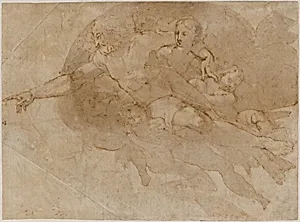
God the Father in Glory
1551 to 1600
Medium
pen and brown ink with brown wash on laid paper
Dimensions
overall: 18 x 24.4 cm (7 1/16 x 9 5/8 in.)
Classification
Drawing
Department
CG-E
Museum
National Gallery of Art, Washington, D.C.
Credit
Gift of Charles Parkhurst
Accession Number
1982.79.1
Rights
Public Domain
Art Historical Context
This drawing, *God the Father in Glory*, captures a majestic celestial figure rendered in fluid pen strokes and rich brown washes. Created between 1551 and 1600 and attributed to the Florentine artist Andrea Boscoli after designs by Michelangelo, the work reflects the enduring influence of the great Renaissance master on later generations of Italian draftsmen. Boscoli, active during the late Mannerist period, skillfully translated Michelangelo’s powerful, sculptural forms onto paper, emphasizing dramatic movement and divine presence. The medium of pen and brown ink with wash on laid paper was especially valued in the sixteenth century for its ability to convey both precise line work and atmospheric depth. Such drawings often served as studies, copies, or presentation pieces, allowing artists and collectors to explore grand compositional ideas on an intimate scale. Measuring just 18 by 24.4 centimeters, this sheet invites close viewing while evoking the monumental grandeur of Michelangelo’s frescoes. Housed in the National Gallery of Art as a gift from Charles Parkhurst, the drawing offers modern visitors a tangible connection to the artistic dialogue between Michelangelo’s heroic vision and the interpretive skill of his successors.