
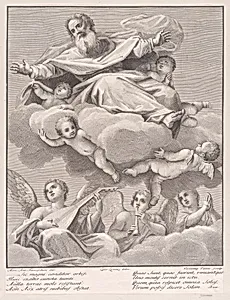
God with musical angels and cherubim
Medium
Etching and engraving
Dimensions
Sheet (Trimmed): 15 3/16 × 11 9/16 in. (38.5 × 29.3 cm)
Classification
Prints
Department
Drawings and Prints
Museum
Metropolitan Museum of Art, New York, NY
Credit
The Elisha Whittelsey Collection, The Elisha Whittelsey Fund, 1951
Accession Number
51.501.2782
Rights
Public Domain
Tags
Art Historical Context
In the late 18th century, Italian artists Lorenzo Lorenzi, Marcant Franceschini, and Violante Vanni collaborated *God with Musical Angels and Cherubim (1774), a etching and engraving now housed in the Metropolitan Museum Art's Drawings and Prints. This print, measuring about 15 by 11 inches, captures a heavenly vision of God the Father enthroned amid a chorus of angels and cherubim, playfully wielding lutes. Produced through the Elisha Whittelsey Collection, it exemplifies the era's devotion to religious iconography, blending Baroque exuberance with emerging Rococo grace. Etching and engraving techniques allowed for intricate details—the soft, fluid lines of etching evoke ethereal mist and fabric folds, while engraving's sharp precision defines the divine figures' expressions and instruments. Franceschini, a Bolognese master known for his dynamic frescoes, likely provided the compositional design, with Lorenzi and Vanni executing the plate. Such prints were vital for disseminating grand religious themes to wider audiences, bridging elite patronage and popular piety during a time of Enlightenment fervor. This artwork invites visitors to ponder celestial harmony, where music symbolizes divine order. A testament to 18th-century printmaking's virtuosity, it remains a luminous highlight of sacred art traditions.
About the Artist
Lorenzo Lorenzi|Marcantonio Franceschini|Violante Vanni (Italian|Italian) · 1750 |1700 –1780 |1800
Italian, active ca. 1750–80|Italian, active Florence, 18th century