
Godard Ginkell
1702
Medium
striking (metalworking)
Dimensions
53.81; 5
Rights
Public Domain
About this artwork
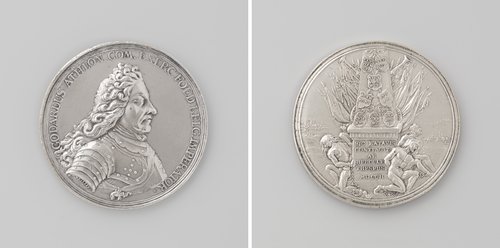
Zilveren penning. Voorzijde: borstsuk man binnen omschrift. Keerzijde: obelisk met vaandels, wapenschilden en opschrift, waaraan vier naakte gevangenen zijn geketend
Art Historical Context
### Godard Ginkell Silver Medal Crafted in 1702 by Dutch medallist Martin Smeltzing, this striking silver medal (zilveren penning) honors Godard van Ginkel, a prominent military leader of the Dutch Republic during the late 17th century. Measuring just 5 cm in diameter and weighing 53.81 grams, its petite scale belies its intricate detail, a hallmark of the Baroque-era medal-making tradition. Smeltzing, known for his precise engraving and striking techniques, used high-relief stamping on silver to create a durable, tactile commemorative piece—ideal for circulation among elites or as a personal token of prestige. The obverse features a detailed bust of a man, likely van Ginkel himself, framed by an inscription that identifies the honoree. The reverse is more dramatic: a towering obelisk adorned with banners, coats of arms, and lettering, from which four naked, chained prisoners dangle symbolically. This imagery evokes van Ginkel's triumphs, possibly alluding to his role in William III's campaigns, such as the capture of key fortresses during the Nine Years' War. Such allegorical motifs were common in Dutch medals, blending classical monumentality with contemporary heroism. As a snapshot of Dutch Golden Age artistry, this medal highlights the era's mastery of metalworking—where hammer and die produced sharp, enduring designs. It offers visitors a glimpse into how 18th-century Europe celebrated military glory through portable, symbolic art. (198 words)