
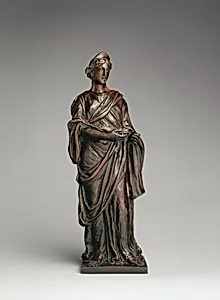
Goddess, after the antique
Unknown Artist
17th–18th century
Medium
Bronze
Dimensions
Overall (confirmed): 13 1/2 × 4 × 3 7/8 in. (34.3 × 10.2 × 9.8 cm)
Classification
Sculpture-Bronze
Culture
Italian
Department
European Sculpture and Decorative Arts
Museum
Metropolitan Museum of Art, New York, NY
Credit
Gift of Ogden Mills, 1924
Accession Number
24.212.25
Rights
Public Domain
Tags
Art Historical Context
Behold the graceful *Goddess, after the antique*, a captivating bronze sculpture from 17th–18th Italy, now gracing the Metropolitan Museum of's European Sculpture and Decor Arts collection. Standing at 13 1/2 inches tall, this elegant figure exemplifies the era's fascination with classical antiquity, serving as a faithful reproduction or interpretation of an ancient prototype. Gifted by Ogden Mills in 1924, it invites visitors to connect with the timeless allure of Greco-Roman ideals. Crafted in bronze—a medium prized for its durability and ability to capture fine details through lost-wax casting—this piece reflects Italy's enduring tradition of reviving ancient forms during the Baroque and Rococo periods. Artists of the time often drew from Roman and Greek sculptures unearthed in archaeological digs, blending reverence for the past with contemporary finesse. The goddess's poised stance and draped form evoke the poise of classical deities, symbolizing beauty, divinity, and harmony. This work highlights the cultural Renaissance of antiquarianism, where Italian workshops produced such bronzes for elite collectors, bridging ancient mythology with 17th- and 18th-century tastes. A testament to artistic continuity, it reminds us how the divine feminine has inspired creators across millennia.