
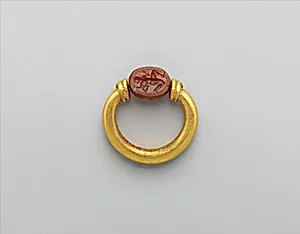
Gold and carnelian ring: on scarab bezel, Herakles
Unknown Artist
early 5th century BCE
Medium
Gold, carnelian
Dimensions
Diam.: 15/16 x 3/8 in. (2.4 x 1 cm)
Classification
Gold and Silver
Culture & Period
Etruscan · Late Archaic
Department
Greek and Roman Art
Museum
Metropolitan Museum of Art, New York, NY
Credit
Harris Brisbane Dick Fund, 1940
Accession Number
40.11.15
Rights
Public Domain
Tags
Art Historical Context
This delicate gold and carnelian, crafted by an unknown Etruscan artist in the early 5th BCE, exemplifies the Late Archaic period's masterful jewelry making. Measuring just 15/16 x 3/8 inches (2.4 x 1 cm), its scarab-shaped bezelfashioned from vibrant red carnelian— an engraving of Herakles, the Greek hero known for his. Acquired through the Harris Brisbane Dick Fund 1940, it resides in the Metropolitan Museum of Art Greek and Roman Art DepartmentEtruscan culture, flourishing in central Italy from around 900–100 BCE, eagerly adopted Greek myths and Egyptian motifs through Mediterranean trade. The scarab form, symbolic of rebirth in Egypt, became a popular bezel style for seals and rings, blending exotic influences with local goldsmithing prowess. Herakles, revered for strength and protection, appears frequently in Etruscan art, suggesting the ring's owner sought amuletic power or status display. The use of gold for the band and setting, paired with carnelian's durability for carving, highlights advanced techniques like granulation and intaglio engraving. Worn daily, such jewels bridged personal adornment and ritual, offering a glimpse into elite Etruscan life before Roman assimilation. Imagine slipping it on— a tiny portal to ancient heroism!