
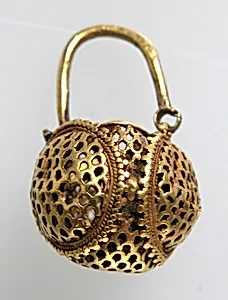
Gold "Basket" Earring
Unknown Artist
6th century
Medium
Gold
Dimensions
Overall: 1 x 9/16 in. (2.5 x 1.5 cm)
Classification
Metalwork-Gold
Culture
Byzantine
Department
Medieval Art
Museum
Metropolitan Museum of Art, New York, NY
Credit
Gift of J. Pierpont Morgan, 1917
Accession Number
17.192.97
Rights
Public Domain
Art Historical Context
This exquisite Gold "Basket" Earring, crafted in the 6th century during the height of the Byzantine Empire, the era's masterful metalworking traditions. Measuring just 1 x 9/16 inches (2.5 x 1.5 cm), its diminutive size belies its intricate design, resembling a finely woven basket—a clever play on form that highlights Byzantine goldsmiths' skill in mimicking organic textures with precious metal. Donated to the Metropolitan Museum Art in 1917 by J. Pierpont Morgan it resides in the Medieval Art department, classified as Metalwork-Gold from Byzantine culture. Byzantine jewelry like this earring was more than adornment; it symbolized wealth, piety, and imperial sophistication under emperors like Justinian I, whose reign saw Constantinople as a crossroads of Roman, Persian, and Christian influences. Gold, prized for its luster and durability, was hammered, twisted, and possibly granulated to create the basket-like weave, techniques inherited from Hellenistic and early Christian artisans. Such earrings, likely worn by elite women, reflected the empire's opulent courtly life and enduring legacy in medieval luxury crafts. Fun fact: Despite its small scale, this piece would have sparkled brilliantly in torchlit basilicas, underscoring how Byzantine metalwork bridged antiquity and the Middle Ages with timeless elegance.