
Gold Bracteate
Unknown Artist
400–600
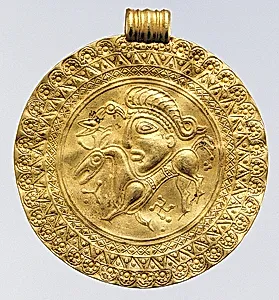
Medium
Gold
Dimensions
1 7/8 x 1 3/4 x 3/16 in. (4.8 x 4.4 x 0.4 cm). .3oz (8g)
Classification
Metalwork-Gold
Culture
Scandinavian
Department
Medieval Art
Museum
Metropolitan Museum of Art, New York, NY
Credit
Purchase, Gift of Dr. Mortimer D. Sackler, Theresa Sackler and Family, and John W. Byington Trust Gift, 2001
Accession Number
2001.583
Rights
Public Domain
Tags
Art Historical Context
Nestled in the Metropolitan Museum of Art's Medieval collection, this exquisite *Gold Bracteate* hails from Scandinavia between 400 and 600 CE, a era known as the Migration Period. Crafted from a mere 8 grams of pure gold, this delicate disc—measuring just under 2 inches across—is a testament to the era's masterful metalworking. Worn as a pendant, it likely served as both jewelry and an amulet, symbolizing or offering protection amid the migrations of Germanic tribes. The bracteate's thin foil was meticulously stamped or tooled to create intricate designs featuring animals, birds, and faces, motifs deeply rooted in Scandinavian pagan beliefs. These enigmatic images—possibly evoking mythical creatures, divine figures like Odin with his ravens, or heroic symbols—reflect the fusion of artistry and spirituality. The repoussé technique, where designs are hammered from the reverse, allowed for fine details on such a lightweight medium, showcasing the anonymous artisan's skill. This rare survivor highlights the cultural richness of early medieval Scandinavia, where gold hoards bridged pagan rituals and emerging Christian influences. Donated through generous gifts in 2001, it invites visitors to ponder the mysteries of a world where myth met metal.