
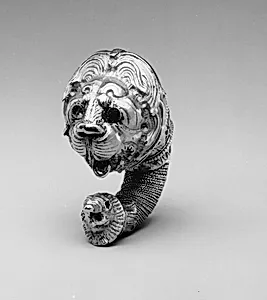
Gold double lion's head earring
Unknown Artist
last quarter of the 4th century BCE
Medium
Gold
Dimensions
H. 1 5/16 in. (3.3 cm) width (front to back) 1 in. (2.6 cm)
Classification
Gold and Silver
Culture & Period
Greek · Hellenistic
Department
Greek and Roman Art
Museum
Metropolitan Museum of Art, New York, NY
Credit
Rogers Fund, 1920
Accession Number
20.236
Rights
Public Domain
Tags
Art Historical Context
This exquisite gold double lion's headarring, crafted in the last quarter of the 4 century BCE during the Hellenistic period, exemplifies the opulent jewelry of ancient Greece. Measuring just 1 5/16 inches (3.3 cm) high 1 inch (2.6 cm) wide, its petite scale belies its intricate design: two fierce lion heads, likely facing outward or back-to-back, forming a bold pendant. Lions, symbols of power, protection, and divine strength in Greek mythology—evoking heroes like Heracles—were popular motifs in Hellenistic art, blending realism with dramatic flair. Hellenistic goldwork, as seen here, showcased advanced metalworking techniques such as hammering, chasing, and granulation, reserved for the elite. This era, following Alexander the Great's conquests (ca. 323–31 BCE), saw cultural fusion and lavish personal adornments reflecting wealth and status. Acquired through the Rogers Fund in 1920, the earring now graces the Metropolitan Museum of Art's Greek and Roman Art department, offering a tangible link to the vibrant world of ancient Mediterranean luxury. Visitors will appreciate how such delicate treasures highlight the Greeks' mastery of form and symbolism, turning everyday wear into statements of ferocity and prestige.