
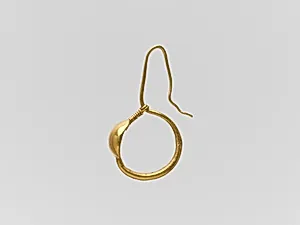
Gold earring with convex disk
Unknown Artist
2nd century CE
Medium
Gold
Dimensions
Other: 1 × 3/8 × 1 5/8 in. (2.5 × 0.9 × 4.2 cm)
Classification
Gold and Silver
Culture & Period
Roman · Imperial
Department
Greek and Roman Art
Museum
Metropolitan Museum of Art, New York, NY
Credit
The Cesnola Collection, Purchased by subscription, 1874–76
Accession Number
74.51.3913
Rights
Public Domain
Art Historical Context
This delicate gold earring, featuring convex disk, hails from the Roman Imperial period in the 2nd century CE time when the empire spanned vast territories, and personal adornments like this symbolized wealth and status. Crafted from pure gold, its petite dimensions (just 1 × 3/8 × 1 5/8 inches) highlight the exquisite metalworking skills of Roman artisans, who fashioned jewelry as both fashion and portable treasure. The convex disk design, a common motif in Roman earrings, likely caught the light elegantly, drawing attention to the wearer's elegance during social gatherings or daily life. In Roman culture, gold jewelry was reserved for the elite, often women of high society, reflecting the era's prosperity and advanced goldsmithing techniques. Such pieces were not merely decorative; they embodied cultural values of luxury and refinement, sometimes incorporating granulation or filigree (though specifics here emphasize the disk's bold form). Unearthed likely from a Roman province like Cyprus, this earring offers a tangible link to imperial daily life. Part of The Cesnola Collection at The Metropolitan Museum of Art—acquired by subscription in 1874–76—this treasure invites us to ponder the faces and stories of its ancient owners, bridging millennia with shimmering finesse.