
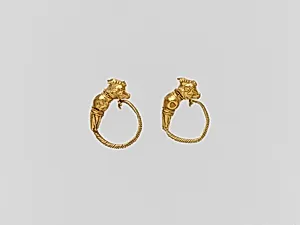
Gold earring with head of a goat
Unknown Artist
4th‒3rd century BCE
Medium
Gold
Dimensions
Diam.: 1 1/8 in. (2.9 cm)
Classification
Gold and Silver
Culture & Period
Greek · Classical or Hellenistic
Department
Greek and Roman Art
Museum
Metropolitan Museum of Art, New York, NY
Credit
The Cesnola Collection, Purchased by subscription, 1874–76
Accession Number
74.51.3479
Rights
Public Domain
Tags
Art Historical Context
This exquisite gold earring, featuring the finely crafted head of a goat,ails from ancient Greece during the 4th3rd century BCE, transitional period between the Classical and Hellenistic eras. just 1 1/8 inches (2.9 cm) in diameter, its petite scale belies its luxurious appeal, designed as personal adornment for elite wearers. Crafted entirely from gold—a precious metal symbolizing wealth and status in antiquity—the earring showcases the advanced metalworking techniques of Greek artisans, likely involving hammering, chasing, and granulation to achieve its detailed, naturalistic form. In Greek culture, goats held symbolic resonance, often linked to rural life, fertility, and deities like Dionysus or Pan, evoking the wild, untamed aspects of nature. Such jewelry reflects the Hellenistic penchant for intricate, animal-inspired motifs that blended realism with symbolic depth, serving both aesthetic and possibly apotropaic (protective) purposes. Part of the renowned Cesnola Collection at The Metropolitan Museum of Art, acquired through public subscription in 1874–76, this piece offers a glimpse into the opulent world of ancient Greek elites, where even small ornaments carried profound cultural weight.