
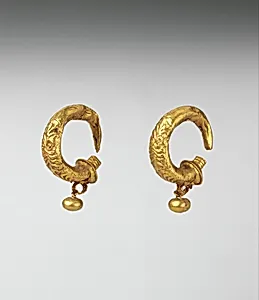
Gold earrings
Unknown Artist
4th–3rd century BCE
Medium
Gold
Dimensions
Diam.: 1 7/8 in. (4.8 cm)
Classification
Gold and Silver
Culture & Period
Etruscan · Classical
Department
Greek and Roman Art
Museum
Metropolitan Museum of Art, New York, NY
Credit
Purchase by subscription, 1895
Accession Number
95.15.188, .189
Rights
Public Domain
Art Historical Context
These exquisite gold earrings, crafted by an unknown Etruscan artisan in the 4th–3rd century BCE, exemplify masterful jewelry-making of ancient Italy's Etruscan civilization. Measuring just 1 7/8 inches (4.8 cm) in, these delicate hoops belong to the Classical period, a time when Etruscan culture flourished before Roman dominance. Acquired by the Metropolitan Museum of Art through a 1895 purchase subscription, they now grace the Greek and Roman Art, showcasing the era's opulent personal adornments. Etruscan goldsmiths were renowned for their technical prowess, particularly techniques like granulation—fusing tiny gold granules into intricate patterns—and filigree wirework, which likely adorns these earrings. Such jewelry symbolized wealth and status, often worn by elite women at banquets or rituals. Influenced by Greek motifs yet distinctly Italic, these pieces highlight the Etruscans' role as cultural intermediaries in the Mediterranean world. Fun fact: Etruscan earrings like these were not just decorative; archaeological finds suggest they held protective or apotropaic powers, warding off evil. A testament to enduring craftsmanship, they invite us to ponder the lives of those who once wore them.