
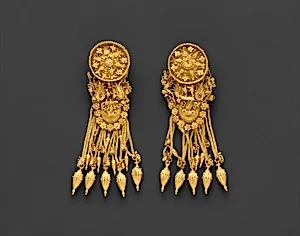
Gold earrings with disk and boat-shaped pendant
Unknown Artist
ca. 300 BCE
Medium
Gold
Dimensions
Overall (A): 2 5/8 in. (6.6 cm) Other (Diameter of disc): 7/8 in. (2.2 cm) Diam.: 3/4 in. (1.9 cm)
Classification
Gold and Silver
Culture & Period
East Greek · Hellenistic
Department
Greek and Roman Art
Museum
Metropolitan Museum of Art, New York, NY
Credit
Rogers Fund, 1948
Accession Number
48.11.2, .3
Rights
Public Domain
Tags
Art Historical Context
These exquisite gold earrings, crafted around 300 BCE by an East Greek artisan during the Hellenistic period, showcase the opulence of ancient jewelry-making. Featuring disk pendants and distinctive boat-shaped drops, they measure about 2⅝ inches overall, with disks roughly ⅞ inch in diameter. Adorned with motifs of Nike—the winged goddess of victory—and horses, symbols of speed, power, and triumph these pieces likely evoked divine favor and elite status for their wearers. Hellenistic art flourished after Alexander the Great's conquests, blending Greek aesthetics with Eastern influences, and East Greek workshops excelled in fine goldwork. Techniques like hammering, chasing, and filigree (inferred from the intricate forms) highlight the era's technical prowess, producing lightweight yet lavish accessories for women of means. Such earrings were not mere adornments but cultural statements, reflecting prosperity in Ionian regions amid expanding trade networks. Today, housed in the Metropolitan Museum of Art's Greek and Roman Art department (Rogers Fund, 1948), they offer a glimpse into daily luxury 2,300 years ago. Visitors can marvel at how these delicate treasures captured the Hellenistic spirit of grandeur and mythology.