
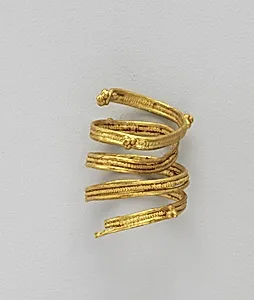
Gold spiral
Unknown Artist
7th–6th century BCE
Medium
Gold
Dimensions
Diam.: 1 in. (2.5 cm)
Classification
Gold and Silver
Culture & Period
Etruscan · Late Geometric-Archaic
Department
Greek and Roman Art
Museum
Metropolitan Museum of Art, New York, NY
Credit
Purchase by subscription, 1895
Accession Number
95.15.135
Rights
Public Domain
Art Historical Context
This delicate **Gold Spiral**, crafted by an unknown Etruscan artisan in the 7th–6th century BCE, is a shimmering testament to the ingenuity of one of ancient Italy's most enigmatic cultures. Measuring just 1 inch (2.5 cm) in diameter, this pure gold piece hails from the Late Geometric-Archaic period, a time when Etruscan society flourished in central Italy, blending local traditions with influences from Greek Geometric art and Eastern motifs. Displayed in the Metropolitan Museum of Art's Greek and Roman Art department—purchased by subscription in 1895—it exemplifies the elite craftsmanship of Etruscan goldsmiths. Etruscans were renowned for their advanced metalworking, and this spiral highlights their skill in hammering and shaping soft gold into precise, elegant forms. Gold, a rare and precious import likely sourced through Mediterranean trade networks, symbolized wealth, status, and divine favor among the aristocracy. Such small ornaments were probably worn as earrings, hairpins, or fibula decorations, adorning the elite during rituals or daily life. Though diminutive, the spiral's simplicity belies its cultural weight: it bridges the rigid Geometric patterns of early iron-age art with the fluid Archaic styles that foreshadowed Roman grandeur. A window into Etruscan innovation, it invites us to marvel at how ancient hands turned humble metal into enduring beauty.