
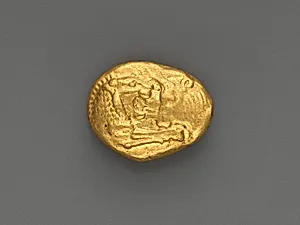
Gold stater
Unknown Artist
ca. 560–546 BCE
Medium
Gold
Dimensions
9/16 × 1/2 in., 0.283oz. (1.5 × 1.2 cm, 8.036g)
Classification
Coins
Culture & Period
Lydian · Archaic
Department
Greek and Roman Art
Museum
Metropolitan Museum of Art, New York, NY
Credit
Gift of The American Society for the Excavation of Sardis, 1926
Accession Number
26.59.4
Rights
Public Domain
Tags
Art Historical Context
Behold the Gold Stater, a shimmering treasure from ancient Lydia (ca. 560–546 BCE), one of the earliest coined currencies. Minted in pure gold and weighing precisely 8.036 grams, this tiny disc—measuring just 1.5 × 1.2 cm—revolutionized trade in the Archaic period. Crafted in the prosperous kingdom of Lydia in western Anatolia (modern Turkey it hails from the reign of King Croesus, whose legendary wealth gave us the phrase "rich as Croesus." Excavated at Sardis, Lydia's capital, this coin entered the Metropolitan Museum of Art in 1926 as a gift from the American Society for the Excavation of Sardis. Lydians pioneered electrum and gold coinage around 600 BCE, replacing cumbersome barter with standardized, stamped metal that guaranteed value through royal authority. Striking techniques hammered intricate designs into heated gold blanks, creating raised reliefs of confronting lions and bulls—powerful symbols of strength, fertility, and royal might. These heraldic beasts, common on Lydian staters, evoked the kingdom's dominion over nature and commerce. As a artifact of Greek and Roman Art's collection, this stater bridges art and economics, showcasing how aesthetic innovation fueled empires. Hold it close, and feel the pulse of antiquity's first "money talks."