
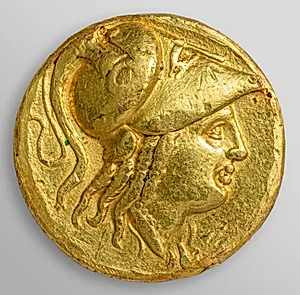
Gold stater
Unknown Artist
ca. 330–320 BC
Medium
Gold
Dimensions
11/16 in. (18 mm)
Classification
Coins
Culture
Greek, Macedon
Department
Greek and Roman Art
Museum
Metropolitan Museum of Art, New York, NY
Credit
Bequest of Nanette B. Kelekian, 2020
Accession Number
2021.40.75
Rights
Public Domain
Art Historical Context
This exquisite gold stater, struck in ancient Macedon around 330–320 BC, the pinnacle of Classical Greek coinage during a transformative era. Measuring just 11/16 inch (18 mm) in diameter, this tiny treasure from the Macedonian kingdom—forged amid the conquests of Alexander the Great—was a high-value coin used for trade, tribute, and military payments. Its pure gold composition reflects Macedon's vast wealth from Thracian mines, symbolizing the rising power of a kingdom that would soon dominate the known world. Artistically, the stater showcases masterful die-engraving techniques, where intricate designs were hammered into thin gold flans under immense pressure. These miniature artworks often portrayed gods like Athena or Victory, blending numismatic precision with Hellenistic ideals of beauty and divinity. As a cultural artifact, it bridged art and economy, circulating Greek influence across empires and serving as portable propaganda for royal authority. Generously bequeathed to the Metropolitan Museum of Art in 2020 by Nanette B. Kelekian, this coin invites us to ponder the ambitions of antiquity—compressed into a gleaming disc that once fueled history's greatest adventures.