
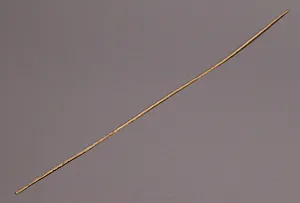
Gold Strip
Unknown Artist
700s
Medium
Gold
Dimensions
23 7/16 × 1/8 × 1/16 in., 0.707 Troy Ounces (59.6 × 0.3 × 0.1 cm, 22g)
Classification
Metalwork-Gold
Culture
Avar
Department
Medieval Art
Museum
Metropolitan Museum of Art, New York, NY
Credit
Gift of J. Pierpont Morgan, 1917
Accession Number
17.190.1645
Rights
Public Domain
Art Historical Context
Behold the delicate *Gold Strip*, a shimmering artifact from the 700s crafted by an unknown Avar artisan. This slender piece of pure gold measures just 23 7/16 × 1/8 × 1/16 inches and weighs a mere 0.707 Troy ounces, exemplifying the finesse of early medieval metalwork. Displayed in the Metropolitan Museum Art's Medieval Art department it entered the collection as a gift from J Pierpont Morgan in 7, highlighting its enduring allure. Hailing from the Avar—a nomadic confederation that dominated the Carpathian Basin from the 6th to 9th centuries—this strip reflects the Avars' mastery of goldsmithing amid their steppe heritage. During the 700s, as the Avar Khaganate faced pressures from Frankish and Slavic forces, such lightweight gold objects likely served as currency, jewelry components, or prestige items, underscoring the portability prized by these horsemen-warriors. In the realm of metalwork, the *Gold Strip* showcases the era's advanced hammering techniques, transforming raw gold into thin, versatile sheets. Its simplicity belies profound cultural importance: Avars buried hoards of such treasures, revealing trade links across Eurasia and a love for opulent adornment. A quiet testament to a vanished world, it invites us to ponder the lives of those who once held its gleam.