
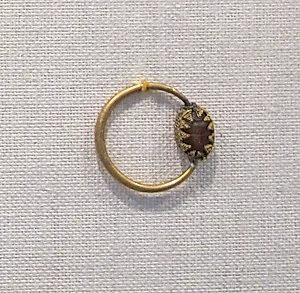
Gold swivel ring with carnelian scarab
Unknown Artist
4th century BCE
Medium
Carnelian, gold
Dimensions
Other: 5/16 x 7/16 in. (0.8 x 1.2 cm)
Classification
Gems
Culture & Period
Etruscan · Classical
Department
Greek and Roman Art
Museum
Metropolitan Museum of Art, New York, NY
Credit
Purchase by subscription, 1895
Accession Number
95.15.106
Rights
Public Domain
Tags
Art Historical Context
Nestled in the Metropolitan Museum of Art's Greek and Roman Art collection this exquisite gold swivel ring a carnelian scarab dates to the 4th century BCE, the refined artistry of Etruscan culture during the Classical period. Crafted from gleaming gold and vibrant red carnelian—a semi-precious stone prized for durability and rich hue—the ring measures a petite 5/16 x 7/16 inches (0.8 x 1.2 cm). The scarab, mimicking the sacred Egyptian beetle, pivots on a swivel mechanism, a clever design allowing it to function as both jewelry and a practical seal. Etruscan artisans, influenced by Egyptian motifs via Greek intermediaries, mastered intaglio carving on gems like carnelian, engraving intricate designs on the scarab's underside for stamping wax seals. These rings symbolized status, protection, and rebirth—the scarab's association with renewal mirroring life's cycles. Acquired by subscription in 1895, this piece highlights Etruscan goldsmithing prowess and their cultural synthesis, bridging Mediterranean worlds before Roman ascendancy. Visitors, imagine slipping this talismanic treasure onto your finger, its swivel revealing hidden messages—a window into an elite Etruscan's daily life.