
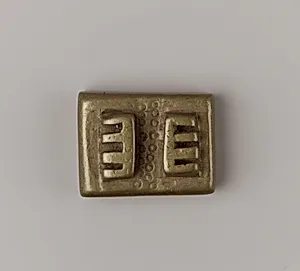
Gold Weight: Geometric
Unknown Artist
16th–17th century
Medium
Brass
Dimensions
H. 1 1/8 × W. 1 7/8 × D. 1/2 in. (2.9 × 4.8 × 1.3 cm)
Classification
Metal-Implements
Culture
Akan peoples
Department
Arts of Africa, Oceania, and the Americas
Museum
Metropolitan Museum of Art, New York, NY
Credit
Gift of Ernst Anspach, 1994
Accession Number
1994.312.3
Rights
Public Domain
Art Historical Context
This petite brass gold weight, crafted by an unknown Akan artist in the 16th–17th century, exemplifies the of West African metalworking from present-day Ghana. Belonging to the Akan peoples particularly the Asante (Ashanti), these small implements—measuring just 1 1/8 inches high—were essential tools for weighing gold dust, the primary currency in regional trade networks. Gold weights like this geometric form were produced in vast quantities, reflecting the Akan's mastery of the lost-wax casting technique, where molten brass was poured into finely detailed molds. The abstract geometric design, with its precise lines and balanced proportions, likely draws from architectural motifs or symbolic patterns in Akan art, embodying concepts of harmony and order central to their worldview. Unlike figurative weights depicting proverbs through animals or humans, this one highlights the Akan's versatility in abstraction, blending functionality with aesthetic refinement. Such objects were not mere tools but cultural artifacts, often used by merchants to negotiate deals and preserve oral traditions. Today, housed in the Metropolitan Museum of Art's Arts of Africa, Oceania, and the Americas department (gift of Ernst Anspach, 1994), this weight invites us to marvel at the Akan's sophisticated economy and artistry, bridging everyday commerce with enduring creative legacy.