
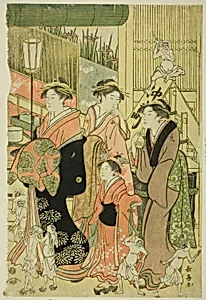
Good and Evil Influences (Zendama akudama)
c. 1795
Medium
Color woodblock print; center sheet of oban triptych (left sheet: 1929.737)
Dimensions
27 × 24.7 cm (10 5/8 × 9 11/16 in.)
Classification
woodblock print
Department
Arts of Asia
Museum
Art Institute of Chicago
Accession Number
22491
Rights
Public Domain
Art Historical Context
Eishosai Choki’s *Good and Evil Influences (Zendama akudama)*, created around 1795, offers a vivid glimpse into late-Edo-period Japan through the lens of ukiyo-e. This color woodblock print forms the central panel of an oban triptych, a format that allowed artists to unfold narrative scenes across multiple sheets. Choki, active in the 1790s, was known for his delicate line work and imaginative compositions that often blended theatrical subjects with moral or fantastical themes. Woodblock printing was the dominant medium for popular imagery in Japan at the time, enabling wide distribution of art that once had been limited to paintings for the elite. Vibrant pigments applied by hand after the initial printing process gave these works their distinctive brilliance. Here, the title suggests a story contrasting virtuous and mischievous forces—common in kabuki-inspired or didactic prints meant to entertain while gently instructing viewers. As part of the Art Institute of Chicago’s collection of Japanese prints, this sheet exemplifies how ukiyo-e captured the cultural imagination of its day. Though only the center panel survives in this museum, its compact size (roughly 10 by 9 inches) and triptych origin remind us of the collaborative, multi-sheet storytelling that delighted audiences in bustling Edo.