
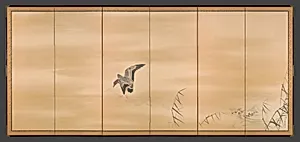
Goose and Reeds; Willows in the Moonlight
right screen: 1774; left screen: 1793
Medium
Pair of six-panel folding screens; ink, color and gold on paper
Dimensions
Each: Image: 60 9/16 in. × 11 ft. 7 1/2 in. (153.9 × 354.4 cm)
Classification
Paintings
Culture & Period
Japan · Edo period (1615–1868)
Department
Asian Art
Museum
Metropolitan Museum of Art, New York, NY
Credit
Mary Griggs Burke Collection, Gift of the Mary and Jackson Burke Foundation, 2015
Accession Number
2015.300.197.1, .2
Rights
Public Domain
Tags
Art Historical Context
Maruyama Ōkyo (1733–1795), a pioneering Japanese artist of the Edo period (1615–1868), created this stunning pair of six-panel folding, *Goose and Reeds; Willows in the Moon*. The right screen dates to 1774, while the left was completed in 1793 showcasing Ōkyo's lifelong fascination with nature. Rendered in ink, color, and gold on paper—each screen measuring over 5 feet high and 11.5 feet wide—these byōbu (folding screens) were luxurious room dividers in elite Japanese homes, their shimmering gold backgrounds evoking misty landscapes and moonlit serenity. Ōkyo founded the Maruyama-Shijō school, blending meticulous realism inspired by Western observation with traditional Japanese ink painting. Here, a solitary goose amid swaying reeds on one screen contrasts with ethereal willows bathed in moonlight on the other, capturing the quiet poetry of seasonal change. His innovative techniques, like fine brushwork for feathers and leaves, brought unprecedented lifelike detail to birds and plants, influencing generations of artists. On view in the Metropolitan Museum of Art's Asian Art department, this pair from the Mary Griggs Burke Collection highlights Edo Japan's cultural reverence for nature's fleeting beauty, inviting visitors to contemplate the harmony of light, water, and wildlife.