
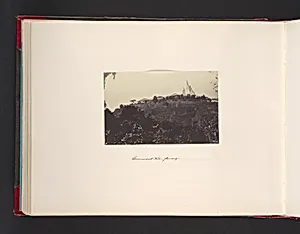
Government Hill. Penang
1865
Medium
Albumen silver print from glass negative
Dimensions
12.7 × 19.8 cm (5 in. × 7 13/16 in.)
Classification
Photographs
Department
Photographs
Museum
Metropolitan Museum of Art, New York, NY
Credit
Gilman Collection, Purchase, Cynthia Hazen Polsky Gift, 2005
Accession Number
2005.100.583 (77b)
Rights
Public Domain
Art Historical Context
In 1865, pioneering photographer John Thomson captured *Government Hill, Penang a striking albumen silver print that offers a window into British colonial life in Southeast Asia. Perched on the Malaysian island of Penang—a key trading hub ceded to the British East India Company in 1786—Government Hill was home to administrative buildings overlooking the bustling harbor. Thomson's image likely frames this elevated vantage with its mix of grand architecture, lush tropical surroundings, and distant sea views, evoking the era's imperial ambition and exotic allure. Thomson, a Scottish explorer-photographer, was among the first to document Asia's diverse cultures through photography during extensive travels from 1862 to 1872. His work, including seminal books like *Illustrations of China and Its People* (1873–74), elevated photography from mere documentation to an artistic medium, blending technical precision with ethnographic insight. This print exemplifies his role in early photojournalism, preserving vanishing colonial scenes for posterity. The albumen silver process, using glass negatives coated in egg-white emulsion, produced the sharp details and rich tones that made 19th-century prints iconic. At 12.7 × 19.8 cm, this intimate format invited close study, highlighting Thomson's mastery of light and composition amid challenging tropical conditions. A gem from the Met's Gilman Collection, it reminds us how photography shaped our understanding of empire and place.
About the Artist
John Thomson · 1837–1921
John Thomson (1837–1921), a pioneering Scottish photographer, was born on 14 June 1837 in Edinburgh as the eighth of nine children to William Thomson, a tobacco spinner and trader, and Isabella Newlands.) After schooling in the early 1850s, he apprenticed with a local optical and scientific instrument manufacturer, where he mastered the principles of photography, completing his training around 185...