
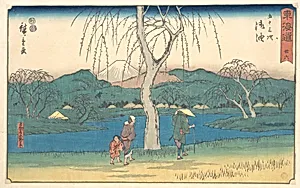
東海道五十三次 御油 古街道本野ヶ原|Goyu
ca. 1840
Medium
Woodblock print; ink and color on paper
Dimensions
Overall: 8 3/4 x 13 3/4 in. (22.2 x 34.9 cm)
Classification
Prints
Culture & Period
Japan · Edo period (1615–1868)
Department
Asian Art
Museum
Metropolitan Museum of Art, New York, NY
Credit
The Francis Lathrop Collection, Purchase, Frederick C. Hewitt Fund, 1911
Accession Number
JP786
Rights
Public Domain
Tags
Art Historical Context
Utagawa Hiroshige (1797–1858), a master of ukiyo-e woodblock prints, captured the poetic beauty of Japan's everyday landscapes in his renowned series *The Fifty-three Stations of the Tkaidō* (ca. 1833–1834, with later editions like this one around 1840). This print depicts the post station at Goyu, the 44th stop on the vital Tōkaidō highway linking Edo (modern Tokyo) to Kyoto during the Edo period (1615–1868). Travelers relied on these stations for rest and relay horses, making the route a symbol of mobility and national unity under the shogunate. In *Goyu: Old Highway at Honnogahara*, Hiroshige renders a serene riverside landscape with figures—men and boys—along the ancient road, evoking the quiet drama of journeying. His signature style emphasizes atmospheric perspective, subtle color gradients, and fleeting natural light, achieved through the collaborative woodblock process: carved blocks inked in vibrant hues (nishiki-e, or "brocade prints") and hand-printed on paper. Tags highlight boys, men, landscapes, and rivers, underscoring themes of human activity amid nature's expanse. These affordable prints democratized art, fueling a travel craze (*tokaidō-mania*) among urban Edoites who vicariously explored beyond city limits. Housed in the Metropolitan Museum of Art's Asian Art collection, this work exemplifies Hiroshige's enduring influence on Impressionists like Monet and Van Gogh.
About the Artist
Utagawa Hiroshige · 1826–1869
Utagawa Hiroshige (1797–1858), born Andō Tokutarō, was the last great master of Japanese ukiyo-e woodblock printmaking and one of the most influential landscape artists in history. Born in Edo (modern Tokyo) into a low-ranking samurai family serving as fire wardens, Hiroshige transformed landscape printmaking into a poetic meditation on nature, weather, and everyday life. His revolutionary approac...